Flying in Costa Rica: What to Expect
What It's Like Flying Sansa and Green in Costa Rica
By Aaron Bailey · Published
I wasn’t prepared for the first time I flew domestically in Costa Rica. I grew up riding shotgun in my dad’s Cesna 172 but flying on Sansa over incredibly beautiful scenery was a completely different experience.
I’d walked from SJO’s international terminal—all gleaming floors and duty-free shops—to a modest building about five minutes away. Inside, a small waiting room. A café selling coffee and snacks. A handful of travelers clutching plastic boarding passes with destinations like Nosara, Tambor, and Drake Bay printed on them.
My route that day: San José to Nosara, then onward to Liberia (LIR). When they called my flight—just a woman with a clipboard announcing the flight number—I followed a small group out a door and onto the tarmac. No jetway. No tunnel. Just open air, the smell of jet fuel, and a white Cessna Caravan waiting with its propeller still.
I climbed a narrow set of stairs, ducked into the cabin, and found myself sitting close enough to the pilot to watch him flip switches on the instrument panel. Twelve seats total. No flight attendant. The safety briefing was a laminated card tucked into the seat pocket.
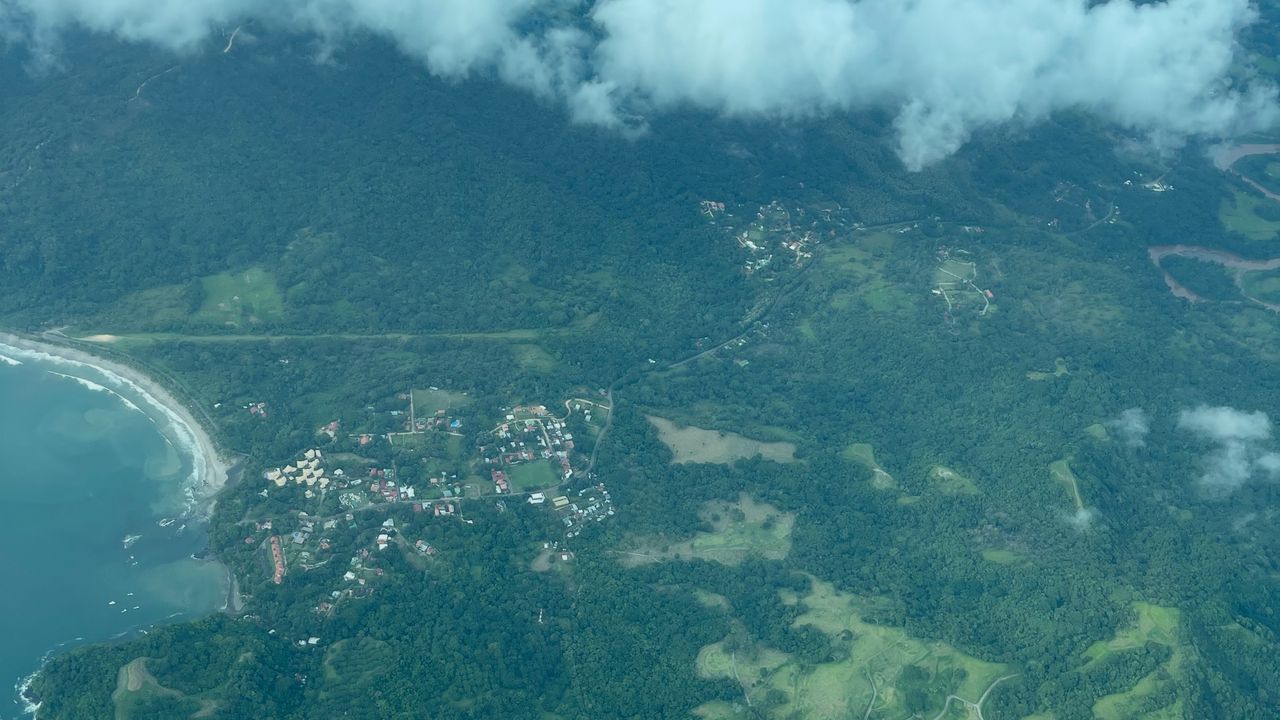
We took off, banked over the Central Valley, and within minutes I was looking down at coastline, green hills stitched with rivers, and the Pacific glinting in the distance. When we landed in Nosara, I watched half the passengers grab their bags and disappear into the humid morning. Then the door closed, and we continued to Liberia—the whole second leg taking maybe twenty minutes.
That was the moment it clicked: this is a completely different way to travel Costa Rica.
The Two Airlines You Need to Know
Costa Rica has two domestic carriers worth knowing about: Sansa and Green Airways.
Sansa is the veteran. It’s been flying since 1978, back when it was a subsidiary of LACSA, the old national airline. Today it operates Cessna 208B Grand Caravans—single-engine, 12- to 14-passenger turboprops that have become the workhorses of Costa Rican domestic travel. Sansa has the most routes by far: Nosara, Tamarindo, Quepos (gateway to Manuel Antonio), Tambor, Puerto Jiménez and Drake Bay (both for Corcovado), Tortuguero, La Fortuna, and even Managua in Nicaragua.
Green Airways is the newcomer, launched in 2019 as part of the Carmen Air charter operation. It’s smaller, with a more limited route network—currently focused on Quepos, Tambor, and Nosara from San José, plus flights to Bocas del Toro in Panama. But Green has a more varied fleet, including Twin Otters, Kodiaks, and King Airs, and their website is notably easier to use than Sansa’s.
Both airlines also offer private charters if you need to reach a more remote airstrip or have luggage that won’t fit the weight limits.
Booking and What It Costs
Expect to pay somewhere between $80 and $120 per person, one way, depending on the route, season, and how far in advance you book. Prices fluctuate like any airline, but that ballpark holds for most destinations. Occasionally you’ll find deals, especially for residents, but tourists should budget around $100 per flight.
The booking process is straightforward on both websites, though Sansa’s site has been known to reject foreign credit cards. If that happens, email their reservations team with your booking details and they’ll process the payment manually. It feels old-school, but it works.
The critical thing to understand before you book: baggage limits are strict. These are small planes with real weight constraints, and the airlines enforce them. Sansa typically allows one checked bag up to 30 pounds and a small carry-on. Green has similar restrictions. Go over the limit and you’ll pay extra—if they can accommodate the weight at all. On some flights, passengers are weighed along with their luggage to calculate the payload.
Pack light. Use soft-sided bags. Leave the rolling suitcase at home.
Connecting To and From International Flights
If you’re flying into Costa Rica and hoping to catch a domestic flight the same day, timing matters.
At SJO (San José):
The domestic terminal is a separate building from the main international terminal, about a five-minute walk. After you land internationally, you’ll need to clear immigration, collect your checked bags, pass through customs, and then walk over to the domestic side. That process can take longer than you expect, especially during peak season.
The standard advice is to allow at least three hours between your international arrival and your domestic departure. Sansa recommends checking in at least an hour before your flight, so you need buffer for everything that comes before. I’ve heard too many stories of people missing their puddle jumper because they assumed immigration would be quick.
Going the other direction—domestic flight connecting to an international departure—is less stressful, but still give yourself 60 to 90 minutes before your domestic flight and plenty of cushion before your international one.
At LIR (Liberia):
Liberia is simpler in one respect: there’s no separate domestic terminal. Sansa and Green operate from the same building as international flights. But you still need to clear immigration and customs, which typically takes about an hour. Sansa requires check-in at least 55 minutes before departure.
The safe bet is at least two and a half hours between an international arrival and a domestic departure at LIR.
The key warning: Don’t cut it close. If you miss a Sansa or Green flight, there might not be another one until the next day. These aren’t airlines with hourly departures. A missed connection could mean an unexpected night in a San José airport hotel—ask me how I know.
The Boarding Experience
Flying domestic in Costa Rica strips away all the ritual of modern air travel and replaces it with something that feels almost improvised.
There are no assigned seats. When they call your flight, you line up, show your ID, and walk out onto the tarmac. First in line gets first pick of seats. If you want a window—and you do—show up early and be ready to move when they announce boarding.
You’ll climb a short set of stairs or a fold-down ladder to enter the cabin. The cockpit isn’t behind a locked door; it’s right there, maybe four feet from the front row. You can watch the pilot go through the preflight checklist, see the instruments, hear the radio chatter.
There’s no flight attendant. No beverage service. No announcements about connecting gates. Just the pilot, a brief taxi, and then you’re in the air.
In the Air: The Good
The views alone justify the price of the ticket.
At cruising altitude in a commercial jet, Costa Rica is an abstraction—a patchwork of green and brown, rivers reduced to threads. In a Cessna at a few thousand feet, you see everything. The corrugated ridgeline of a volcano. Howler monkeys’ territory marked by the canopy they haven’t touched. Surfers as tiny dots in the lineup at a beach break. The way the jungle abruptly ends where a farm begins.
The flights are short—often 30 to 45 minutes—but they cover distances that would take four or five hours by car. San José to Quepos, the gateway to Manuel Antonio, is about a 3.5-hour drive through mountain curves. By air, it’s 25 minutes. San José to Drake Bay, on the Osa Peninsula, would be a full-day journey involving a car and a boat. The flight takes 50 minutes.
For travelers short on time or patience for winding roads, domestic flights are a legitimate time-saver. And there’s an adventure quality to it—something about walking across a tarmac to a propeller plane feels like travel used to feel, before it became an exercise in queue management.
In the Air: The Real Talk
Small planes fly differently than big ones. You feel more. Turbulence that wouldn’t register on a 737 will bounce you around in a Caravan. Updrafts, downdrafts, crosswinds—you notice them all.
This isn’t dangerous; these pilots fly these routes daily and know the conditions intimately. But if you’re a nervous flyer, be prepared. The ride can be bumpy, especially in the afternoon when thermals build up.
Weather cancellations are a real possibility, particularly in the rainy season (roughly May through November). Morning flights tend to be more reliable. If your domestic flight is critical—say, you need to catch an international connection—don’t book the last flight of the day and don’t fly without a backup plan.
Also worth knowing: these planes are not pressurized, and the altitude changes can affect your ears more than a commercial flight. Chewing gum or swallowing during ascent and descent helps.
Landing at Tiny Airstrips
Some of the domestic airports barely qualify as airports. Quepos has an asphalt runway, but for years it was dirt—and not particularly well-maintained dirt. Drake Bay’s airstrip is a grass field. Nosara and Tambor are small and scenic, carved into the landscape rather than imposed on it.
Landing at these strips is an experience. The approach is often steep, the runway short, and the stop quick. You feel the pilot working the plane down, then the firm contact with the ground, then aggressive braking or reverse thrust. It’s not violent, but it’s noticeable.
And then the door opens, and you step out into whatever climate you’ve arrived in—humid jungle air in Drake Bay, Pacific breeze in Nosara, the dry heat of Guanacaste. Your bag appears within minutes, offloaded by hand onto a cart. There’s no carousel. No long walk through terminals. You’re just… there.
Practical Tips for First-Timers
Pack light. I can’t stress this enough. The 30-pound limit is real, and they will weigh your bag. Soft-sided duffels are better than hard-shell suitcases.
Arrive early. 60 to 90 minutes before departure for domestic flights. The terminals are small and check-in is quick, but you don’t want to be the person sprinting across the tarmac.
Book morning flights. Weather is more predictable early in the day, and if something does go wrong, you have time to rebook or make alternative arrangements.
Build buffer into connections. Three hours minimum at SJO between international and domestic. Two and a half at LIR. More if you’re anxious.
Have a backup plan. Know the shuttle or rental car option for your route in case your flight is cancelled. This is especially important in the rainy season or for remote destinations.
Sit on the right side. For many routes (like SJO to Nosara or Quepos), the best views of the coastline are on the right side of the plane. But honestly, both sides are good.
Who Should Fly—and Who Shouldn’t
Domestic flights in Costa Rica make sense if you’re short on time, want to skip a long drive, or need to reach somewhere like Tortuguero that’s genuinely difficult to access by road.
They’re also worth it if you appreciate the experience itself—the small-plane adventure, the low-altitude views, the sense of traveling the way people did before highways smoothed everything out.
They’re probably not worth it if you’re on a tight budget (shuttles are cheaper), have heavy luggage (you’ll pay overweight fees or have to leave things behind), or get anxious in small aircraft.
And they require a certain flexibility. These flights sometimes get cancelled. Schedules shift. The infrastructure is charming but imperfect. If you need absolute certainty, rent a car.
But if you can embrace a little unpredictability, flying Sansa or Green is one of the most memorable ways to see Costa Rica—not just as a destination, but as a landscape unfolding beneath you, one volcanic ridge and river mouth and palm-lined beach at a time.
That first flight from SJO to Nosara to Liberia, I spent most of it with my face pressed to the window. I’ve taken these puddle jumpers a dozen times since, and I still do.

About the Author
Aaron Bailey
Hey, I'm Aaron and I've been living in Costa Rica 5 years and visiting much longer than that. I've traveled all over this country by car, plane and shuttle and I'm here to help you plan the best trip to Costa Rica.
Read more about Aaron