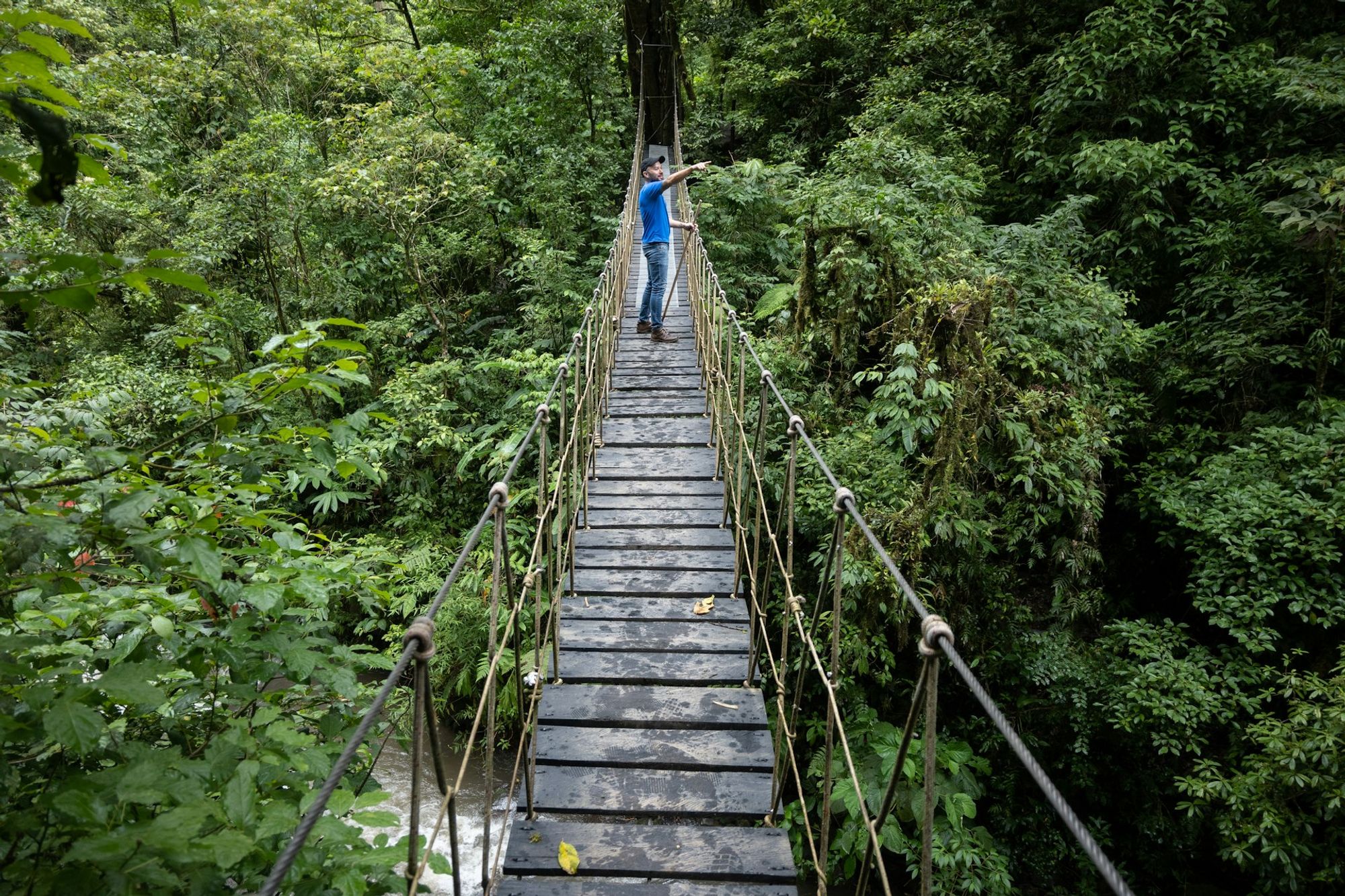
Monteverde Cloud Forest Biological Reserve, Costa Rica
By Aaron Bailey · Last updated
The Monteverde Cloud Forest Biological Reserve is 10,500 hectares of primary cloud forest draped over the continental divide, with a tight network of mossy trails and a justified reputation as one of the best birding sites in the Americas.
Top attractions & tours
The classic half-day loop combines Sendero Bosque Nuboso, Sendero El Río, and Sendero Pantanoso — about 3 hours of root-laced trail through dripping primary forest, with strangler figs, bromeliads, and a strong chance of toucanets and quetzals at dawn. The trails are well-graded but slippery; rubber boots are rented at the entrance.
From the main loop a spur climbs to La Ventana, a wind-blasted lookout straddling the continental divide where the Atlantic and Pacific slopes meet. On a clear morning you can see across both watersheds; most days you stand in the cloud itself. Sendero Chomogo is the highest path in the reserve at about 1,680 m and connects to a small hanging bridge over the canopy.
Near the entrance, the Hummingbird Gallery keeps a row of feeders that pull in 14+ species including the violet sabrewing, the largest hummingbird in Central America — free to visit and worth twenty minutes with a coffee from the adjacent Cafetería Colibrí. Hiring a naturalist guide for a dawn or night walk dramatically raises your odds with quetzals, sloths, and viperids.
Local picks
Most lodging and food is 6 km downhill in Santa Elena, the access town. Stella's Bakery and Orchid Coffee are the classic pre-hike breakfast stops on the road up to the reserve. Café Monteverde sources beans from the local co-op and is the best straight cup in town.
Treehouse Restaurant, wrapped around a living higuerón tree in the middle of Santa Elena, is the easy lunch pick after a morning in the reserve. The Monteverde Cheese Factory (Quaker-founded, 1950s) still sells the best cheese in the country plus grilled-cheese sandwiches and milkshakes for the drive back.
Reputable guides for inside the reserve can be booked at the ticket window or through any Santa Elena hotel — guided walks run roughly $20–25 per person and dramatically improve wildlife sightings. The reserve itself runs official 2-hour night tours that require advance booking and depart from the visitor center after closing.
Weather & climate
The reserve sits between 1,400 and 1,800 meters on the continental divide. Daytime highs are in the upper 60s to low 70s°F, nights drop to the high 50s, and a steady fine mist or horizontal wind-driven rain is normal in any month.
There is no real dry season inside the cloud forest — the trade winds push moisture up the Atlantic slope year-round. January through April are the comparatively drier months, with more chance of a clear ridge view.
Mornings have the best visibility before clouds build. Bring a rain shell, a fleece, and footwear that handles mud; cotton stays wet all day at this elevation.
Monthly climate
Safety considerations
Trails are perpetually wet and the roots, stone steps, and boardwalks are extremely slippery — twisted ankles are by far the most common injury. The reserve caps daily entries and closes at 4 pm; do not start a long loop after 2 pm because dusk in the forest is essentially dark.
Wind on La Ventana and the upper hanging bridge can be ferocious and visibility drops to a few meters in seconds. Pit vipers (eyelash viper, fer-de-lance) live in the forest — stay on the trail, watch where you put your hands, and never reach into vegetation.
Getting around
The reserve entrance is about 6 km southeast of Santa Elena on a paved but steep mountain road. Local taxis run a fixed fare of roughly $10–15 each way, most hotels arrange shuttle pickups, and the local bus from Santa Elena runs a few times a day for under $2.
Roads into the Monteverde area from the Pan-American Highway are partially unpaved, switchbacked, and foggy after dark — arrive in daylight and consider a high-clearance vehicle in the green season. Uber does not operate here; the scenic Jeep-Boat-Jeep transfer to La Fortuna is the most enjoyable way out.
When to visit
February and March are the driest, sunniest months and give you the best chance of clear ridge views from La Ventana — also peak resplendent quetzal breeding season, when the males are easiest to spot near wild avocado trees.
Green season (May–November) turns the forest spectacularly lush and moss-heavy, with fewer crowds and lower lodging rates. You will get wet, but wildlife is more active and the photography is dramatically better in the soft, diffuse light.